
Zurich, 07.05.2026
Flex Suisse and the New Legal Economy:
Unlocking Legal Capability on Demand
How technology, AI and flexible talent models are reshaping Legal & Compliance work
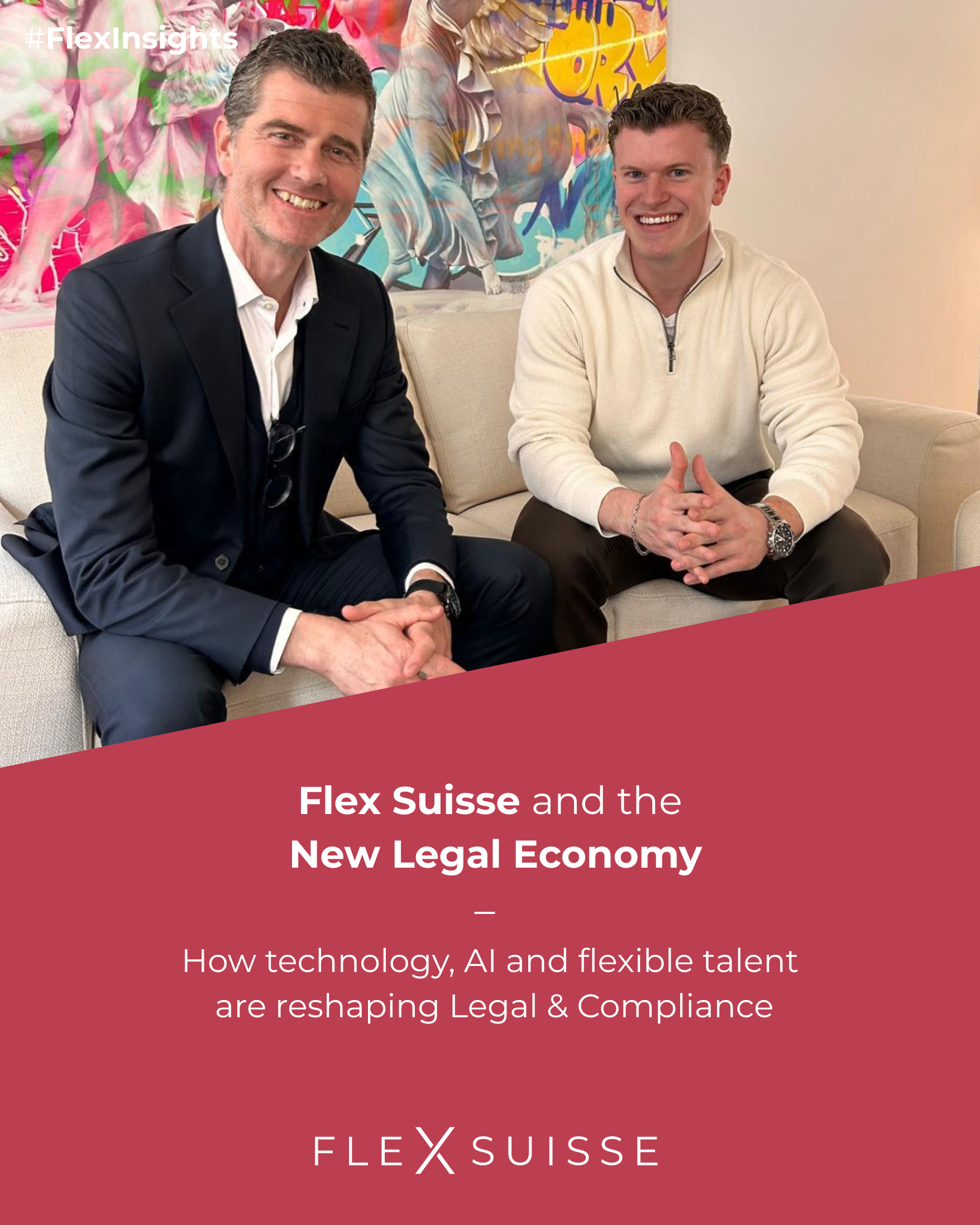
Flex Suisse CEO Nicolai Mikkelsen was recently interviewed by Colin Mathis, Research Assistant at the University of St. Gallen (HSG), on the evolution of legal staffing, the role of technology in the legal and compliance market, and why flexible access to legal talent is becoming increasingly important.
The conversation touched on a central question for today’s legal market:
How can companies access high-quality legal and compliance expertise faster, more efficiently and more flexibly, without compromising on trust, quality or regulatory standards?
For Nicolai, the answer lies in a fundamental shift away from rigid traditional models and towards a more dynamic infrastructure for legal capability.
Beyond Law Firms and Traditional Staffing
Asked how he would describe Flex Suisse compared to traditional law firms or staffing agencies, Nicolai made a clear distinction.
Flex Suisse does not provide legal advice in the way a law firm does. Nor does it simply forward CVs like a traditional recruitment agency. Instead, its role is to give organizations access to the right legal and compliance capability when they need it.
“We don’t sell advice. And we don’t sell profiles. We provide access to capability, on demand.”
This distinction is important. Legal departments today face increasing volatility: regulatory change, project peaks, internal restructurings, parental leaves, investigations, remediation projects, compliance backlogs and cost pressure. In such an environment, the ability to access specialized legal and compliance professionals quickly is no longer a convenience. It is becoming a strategic necessity.
Flex Suisse was built around that need: matching companies with qualified legal and compliance professionals for interim, project-based or permanent requirements in a way that is faster, more flexible and more cost-efficient than traditional models.
Technology as the Operating System
Flex Suisse is often described as highly digital. For Nicolai, this does not simply mean using modern tools. It means designing the company around technology from the ground up.
Matching, onboarding, compliance checks, time tracking and invoicing are not treated as isolated administrative steps. They are integrated into a system designed to reduce friction throughout the entire staffing process.
The logic is simple: every hour spent on avoidable administration is an hour not spent understanding the client’s needs, assessing the right professional fit or ensuring quality in delivery.
Technology therefore does not replace the human element. It strengthens it.
“Technology doesn’t replace relationships, it amplifies them.”
This is an important point. In legal and compliance staffing, trust remains decisive. Clients need to know that the professionals presented to them are not only technically qualified, but also suitable for the specific environment, culture, seniority level and regulatory context.
Digital processes help make this faster and more precise. But the final value still lies in understanding people, context and risk.
The Role of AI: Augmentation, Not Replacement
Artificial intelligence is a natural next step in this evolution.
For Flex Suisse, AI is used to improve the speed and intelligence of the matching process: identifying patterns, surfacing relevant profiles, supporting fit assessments and reducing manual inefficiencies.
But Nicolai is clear that the goal is not to remove human judgment from the process.
“The future of our industry isn’t human or machine. It’s human with machine: better informed, faster and more precise.”
That distinction matters. Legal and compliance work is highly contextual. A good match depends not only on keywords in a CV, but on industry experience, regulatory exposure, seniority, availability, language skills, personality, stakeholder management and the specific nature of the mandate.
AI can support this process. It can accelerate it. It can make it more data-driven. But in a market built on trust, confidentiality and judgment, the human layer remains essential.
Cost Efficiency Without Compromising Quality
One of the strongest market arguments for flexible legal staffing is cost efficiency.
Traditional legal service models often carry significant structural costs: partnership models, large overheads, internal hierarchies and billing structures that clients ultimately pay for. Flex Suisse takes a different approach by focusing on what creates direct value: expertise delivered efficiently.
“Clients pay for impact, not infrastructure.”
This is not about being the cheapest option. That would be the wrong benchmark.
The real value lies in giving clients access to high-quality legal and compliance professionals without unnecessary structural cost, long hiring timelines or permanent headcount commitments.
In practice, this means clients can scale legal capacity up or down depending on demand, while professionals gain access to meaningful work with more flexibility and autonomy.
Legal Tech, ALSP or Something Else?
The legal market often tries to categorize companies like Flex Suisse as Legal Tech providers, Alternative Legal Service Providers, recruitment firms or staffing agencies.
Nicolai sees those labels as partially correct but incomplete: “Flex Suisse operates within the ALSP space. It uses technology deeply. It specializes in legal, compliance and risk talent. But the broader ambition is different: Flex Suisse is building a platform for legal capability. A place where demand and expertise meet faster, smarter and with less friction.”
That positioning is stronger than simply calling Flex Suisse a staffing provider. It reflects where the market is moving: away from static structures and towards more fluid access to specialized expertise.
Trust, Data Protection and Compliance by Design
A technology-driven model in the legal sector only works if trust is built into the foundation.
Flex Suisse operates in highly regulated environments, particularly across legal, compliance, financial services, insurance, pharma and other regulated industries. That means confidentiality, data protection and regulatory compliance are not secondary considerations. They are part of the operating model.
Systems and processes must be aligned with Swiss and EU data protection standards, including GDPR. Confidentiality, secure handling of candidate and client data, and regular review of systems are essential.
As Nicolai put it: “You can’t build the future of legal services if you don’t respect the foundations of the profession.”
That is the balance the market increasingly demands: innovation without carelessness, speed without shortcuts, flexibility without sacrificing professional standards.
“Uber for Lawyers”? A Useful but Imperfect Analogy
Flex Suisse is sometimes described as the “Uber for lawyers.”
Nicolai understands the comparison, but sees it as incomplete.
Uber changed expectations around access, speed and control. In that sense, the comparison works: Flex Suisse is also changing how clients access professional capability and how professionals engage with work.
But there is a clear limit to the analogy. Legal and compliance work is not gig work. It requires expertise, trust, professional judgment, confidentiality and regulatory awareness. The goal is not to commoditize legal professionals. The goal is to give them more freedom without lowering the standard of work.
“This isn’t gig work. This is freedom without compromise.”
For clients, that means access to high-level expertise when it is needed. For professionals, it means the ability to work flexibly without stepping out of serious, meaningful legal and compliance work.
Building the Infrastructure for a New Legal Economy
The legal and compliance market is changing.
Companies need more agility. Legal and compliance teams are under pressure to do more with less. Professionals increasingly want career models that offer autonomy, variety and flexibility. Technology and AI are making faster, smarter matching possible.
Flex Suisse sits at the intersection of these shifts. It is not merely filling vacancies. It is helping redesign how legal and compliance work is accessed, delivered and scaled.
As Nicolai summarized: “We’re building the infrastructure for a new legal economy.”
That may be the clearest way to understand Flex Suisse: not as a law firm, not as a traditional recruiter, and not simply as a technology company, but as a platform enabling legal and compliance expertise to move through the market more efficiently.
For clients, that means speed, flexibility and access to specialized capability. For professionals, it means freedom, meaningful work and new career paths. And for the legal market as a whole, it points towards a future where quality and flexibility are no longer opposites, but part of the same model.

Zurich & Frankfurt, 12.03.2026
Making interim Legal & Compliance staffing work
The model is becoming mainstream. Here’s what separates the teams that benefit from those that don’t.
Legal and compliance departments are facing a structural challenge that isn’t going away. Regulatory demands are intensifying. Automation and efficiency drives are reducing permanent headcount. And when workload spikes — whether from a regulatory investigation, a compliance backlog, or a major transaction — internal hiring processes rarely move fast enough to keep pace.
The response from forward-thinking legal teams has been a quiet but significant shift in how they think about resourcing. Interim legal staffing is no longer the fallback option it once was. For many departments, it’s becoming a deliberate and permanent part of how they manage capacity, risk, and expertise.
But there’s a meaningful gap between organisations that use interim staffing well and those that treat it as a transactional last resort. The difference comes down to understanding what the model actually is — and how to make it work.
What Interim Staff Leasing Actually Means
Interim legal staff leasing operates through what’s known as a triangular employment relationship. The staffing provider employs the professional. The client directs and supervises their work. The professional performs services on assignment.
This structure matters more than it might seem. It means the leasing company remains the legal employer throughout the engagement — handling payroll, social security contributions, insurance, and regulatory compliance. The client gets operational control without the administrative and employment law complexity that comes with direct hiring.
In Switzerland, staff leasing is a regulated activity that requires licensed providers. This means working with a compliant partner isn’t just good practice — it’s a legal requirement.
When Interim Legal Support Makes Strategic Sense
The use cases are broader than most teams initially assume. Interim legal professionals are well-suited to situations where workload or expertise requirements outpace internal capacity — and that covers more ground than emergency cover.
Common scenarios include regulatory remediation and internal investigations, KYC and compliance backlogs, cover during parental leave or extended illness, transaction peaks and post-merger integration, and situations where a hiring freeze has been imposed despite rising demand. In each case, the goal is the same: maintaining capability without taking on permanent headcount.
Used thoughtfully, interim professionals aren’t emergency substitutes. They’re a flexible capability layer — one that can strengthen resilience without adding structural overhead.
What a Good Provider Actually Delivers
One of the most persistent misconceptions about interim staffing is that providers are essentially recruiters — people who forward CVs and step back. A strong interim staffing partner does considerably more than that.
The best providers invest time in understanding the regulatory and operational context of the assignment before they begin searching. They assess environment fit alongside technical expertise, handle all employment, payroll, and social obligations, ensure regulatory compliance throughout, and stand behind their placements — providing continuity or replacement where necessary.
Put simply: clients aren’t purchasing a CV. They’re outsourcing complexity, compliance risk, and time-intensive administrative processes to a specialist. That’s a very different value proposition from traditional recruitment.
Common Misconceptions Worth Addressing
Despite its growing relevance, interim legal staffing still encounters a handful of persistent doubts. Most of them don’t hold up to scrutiny.
“It’s too expensive.” Compared to permanent hiring, interim staffing eliminates long-term cost risk and avoids the structural overhead of a full-time position. For time-limited needs, it’s often the more cost-effective model.
“Interim professionals aren’t committed.” Many interim experts are senior specialists who have deliberately built project-based careers. Their engagement and professional standards are no different from — and are often sharper than — permanent employees who have been in the same role for years.
“This is just temporary work.” In legal and compliance, interim typically means highly specialised expertise. These are professionals who have accumulated deep experience across multiple regulatory environments and can hit the ground running in ways that generalist hires cannot.
“We lose control of the work.” Clients retain full operational control. The provider manages employment responsibilities — not the work itself.
How to Make It Work: Practical Guidance for Legal Teams
Interim staffing delivers its full value when it’s approached as a structured partnership rather than a transactional request. The following practices make a measurable difference to speed, candidate quality, and overall outcomes.
1. Invest in the Briefing
The quality of the output is directly proportional to the quality of the input. A thorough briefing — covering scope, priorities, regulatory pressure points, reporting lines, seniority level, and working model — gives the provider what they need to run a targeted search. Vague briefs produce vague results.
2. Be Transparent About Budget Upfront
Context shapes quality. Budget shapes precision. Without a clear budget range, providers have to guess at the appropriate seniority level and will often iterate through several rounds before landing in the right area. Sharing this information at the outset eliminates unnecessary back-and-forth and accelerates delivery.
3. Consider a Primary Provider Relationship
The instinct to send a requirement to multiple agencies simultaneously is understandable — it feels like it should increase competition and speed. In practice, it often produces the opposite. The same candidates tend to appear through multiple channels, pricing aligns rather than competes, and accountability becomes diffuse.
Working with a trusted primary partner typically leads to better market access, clearer ownership, and faster, higher-quality delivery. Competition may feel safer; partnership tends to produce better outcomes.
4. Give Structured Feedback on Candidates
Feedback is one of the most powerful quality drivers in any interim partnership, and one of the most commonly neglected. Structured feedback after screening and interviews enables the provider to continuously refine their search — tightening alignment, improving shortlist quality, and reducing the number of iterations needed over time.
5. Enable Fast Onboarding
Speed matters at both ends. Top candidates don’t wait indefinitely. Preparing system access, compliance onboarding, and stakeholder introductions in advance ensures the professional can contribute immediately — and prevents losing strong candidates to organisations that move faster.
6. Integrate Interim Professionals as Contributors
Interim experts create the greatest value when they’re included in relevant meetings, decision flows, and documentation — not kept at arm’s length as temporary outsiders. The faster an interim professional can develop context and ownership, the faster they can contribute meaningfully.
7. Maintain an Ongoing Partnership Mindset
Keeping your staffing partner informed about evolving needs, upcoming projects, and organisational changes allows them to anticipate demand and identify suitable profiles ahead of time. Familiarity and continuity significantly improve responsiveness and fit over successive engagements.
The Bigger Picture: How Legal Resourcing Is Changing
Interim legal staffing reflects a broader structural shift that is already well established in consulting, finance, and technology. Legal departments are moving toward leaner core teams complemented by flexible expertise layers — scaling project-based capacity on demand, accessing specialised knowledge without permanent commitment, and building resilience into their operating model.
This isn’t a temporary workaround. It’s a structural response to an environment where workloads are volatile, regulation is intensifying, and the cost of maintaining a fully-staffed permanent team for every eventuality is neither practical nor justified.
The Bottom Line
Interim legal staffing is not about filling gaps. At its best, it’s about adding capability, managing risk, and staying adaptable in a regulated environment that demands both.
Used strategically, it strengthens legal departments. Used tactically, it solves immediate problems. Used poorly, it creates friction.
The difference lies in clarity, integration, and the quality of the partnership. Teams that invest in getting those things right consistently get more value — faster, and with less administrative burden — than those that treat it as a last resort.

Zurich & Frankfurt, 25.02.2026
How Lawyers Should Work With Recruiters
Most lawyers will work with a recruiter at some point in their career. Very few are ever told how to do it well. As a result, many candidates feel frustrated, misrepresented, or disappointed—not because recruiters are inherently bad, but because expectations are unclear on both sides.
This article isn’t about defending recruiters. It’s about helping lawyers use recruiters properly, protect their interests, and make smarter career decisions.
Understanding the Landscape: Law Firm Searches vs. In-House Searches
One of the biggest mistakes job seekers make is assuming all legal searches work the same way. They don’t. Law firm searches are often driven by immediate leverage, billing potential, pedigree, and market signalling. These searches focus on short-term commercial needs and what a candidate can deliver from day one in terms of billable hours and client relationships. In-house searches, on the other hand, prioritize risk appetite and judgement, stakeholder management, adaptability and execution, and long-term fit and retention. The same CV that looks impressive to a law firm may fall flat in-house, and vice versa. A good recruiter understands this distinction and helps you reframe your experience accordingly, emphasizing different aspects of your background depending on the context.
The Recruiter Business Model: Retained vs. Contingent
Most candidates don’t realize there are fundamentally different types of recruiters, and understanding this distinction matters more than you might think. Retained recruiters are hired exclusively by a client and paid to manage the entire search process. They usually control the narrative, timeline, and feedback loop, and they have significant influence over how candidates are presented and evaluated. Contingent recruiters, by contrast, are paid only if a placement is made. They may be competing with other recruiters on the same role and often have limited influence over the client’s decision-making process.
Neither model is inherently bad, but they behave very differently. If a recruiter is working on a contingent basis, you need to be realistic about how much influence they actually have, how many other candidates they might be submitting, and how controlled the process really is. Transparency here matters, and a good recruiter will be upfront about their relationship with the client and what that means for you.
Choosing the Right Recruiter and Spotting the Wrong One
Not all recruiters are created equal, and choosing the right one can make the difference between a smooth, productive process and a frustrating waste of time. A good recruiter should specialize in your market—not just “legal” in general—and understand your role beyond the job title. They should be able to explain why a role exists, what problem the client is trying to solve, and whether your background genuinely aligns with those needs. Perhaps most importantly, they should be willing to tell you when a role isn’t right for you, rather than pushing you toward something that doesn’t fit.
Red flags to watch for include vague job descriptions that lack detail or context, reluctance to name the client without a legitimate reason, and a tendency to oversell opportunities instead of explaining the trade-offs involved. If the interaction feels rushed, unclear, or transactional, trust that instinct. The best recruiters take time to understand your goals and provide honest, strategic advice—even when it means walking away from a potential placement.
Confidentiality and Control: Protecting Your Professional Reputation
Your CV should never be sent anywhere without your explicit consent. This is non-negotiable. Before any submission, you should always ask who will see your profile, whether it will be anonymized initially, and how many other people are being approached for the same role. “Market testing” your CV without clarity or permission can damage your positioning, especially in small legal markets where word travels fast and reputations are built over years.
Good recruiters protect your confidentiality not just as a courtesy, but because it protects their own reputation as well. They understand that trust is the foundation of any successful placement, and they won’t jeopardize that by being careless with your information. If a recruiter is evasive about where your CV is going or who will see it, that’s a serious warning sign.
Your CV Isn’t the Product – You Are
It’s easy to think of recruiters as people who send CVs to clients, but that’s a fundamental misunderstanding of what good recruitment actually involves. Recruiters don’t get paid for sending CVs—they get paid for placing people. That means a good recruiter should help you shape your narrative, decide which experiences to emphasize and which to downplay, and adjust your story depending on the specific role and context.
This is particularly important for in-house roles, where hiring managers care less about pedigree and more about judgement, decision-making, and influence. A recruiter who simply forwards your CV without adding context, framing your experience strategically, or advocating for your fit isn’t really recruiting—they’re just transmitting data. The value lies in the interpretation, positioning, and relationship management that happens around the CV, not in the document itself.
Timing Matters More Than Readiness
Many lawyers wait until they feel “100% ready” to speak to a recruiter, but this approach often backfires. In reality, the market rarely aligns perfectly with personal readiness. Great roles often appear unexpectedly, and the best opportunities don’t wait for you to feel prepared. Moreover, saying “not now” to a recruiter – when done thoughtfully and professionally – can actually strengthen your profile by demonstrating that you’re selective and strategic about your career moves.
Good recruiters think in multi-year timelines, not just immediate placements. They’re building relationships and understanding career trajectories, not just filling roles. You don’t need to be actively looking to have a valuable conversation with a recruiter. In fact, some of the most productive discussions happen when there’s no immediate pressure, allowing for honest reflection on long-term goals and market positioning.
Working With Multiple Recruiters Without Burning Bridges
It’s perfectly acceptable to speak with multiple recruiters, but doing so requires discipline and clear communication. You should always know exactly who is representing you, to which client, and for which specific role. Duplicate submissions—where two different recruiters submit your CV to the same client—can seriously damage your credibility and confuse hiring managers, often resulting in your candidacy being withdrawn entirely.
The best approach is to be transparent with recruiters about your other conversations and to establish clear boundaries about representation. If you’re unsure whether your CV has already been submitted somewhere, ask before giving permission for a new submission. Most recruiters will respect this approach and appreciate the clarity it provides.
Salary, Title, and the Myth of Endless Negotiation
There’s a common misconception that everything is negotiable and that skilled negotiation can dramatically change compensation packages. While there’s some truth to this, most compensation decisions are actually shaped well before interviews begin, based on internal benchmarks, budget constraints, and market data. Recruiters can help by aligning expectations early, avoiding miscommunication about what’s realistic, and advising when to push and when not to.
Misaligned expectations around salary and title are one of the most common reasons offers fail, and these failures waste everyone’s time. Honest conversations early in the process—about what you’re currently earning, what you’re hoping for, and what the market will bear—save everyone time and prevent disappointment down the line. A good recruiter will have the difficult conversations upfront rather than letting unrealistic expectations fester.
Interim and Contract Roles: A Different Dynamic
Interim and contract roles operate on a different basis than permanent placements, built primarily on trust, availability, and delivery. In this market, your reputation compounds quickly. Good performance leads to repeat work and strong referrals, while poor execution is remembered and can close doors for future opportunities. In interim markets, recruiters don’t just place you once and move on—they actively decide whether to come back to you for the next opportunity, and that decision is based entirely on how you performed last time.
This creates a different kind of relationship with recruiters, one that’s more ongoing and performance-based. The best interim professionals treat every assignment as an audition for the next one, and they maintain strong relationships with a small number of trusted recruiters who understand their capabilities and working style.
Feedback: Why You Don’t Always Get It
One of the most frustrating aspects of working with recruiters is the frequent lack of detailed feedback after interviews or rejections. Sometimes feedback genuinely exists but can’t be shared for legal or diplomatic reasons. Other times, it simply doesn’t exist—the client made a gut decision or chose another candidate for reasons they can’t fully articulate.
What you can do is ask for themes rather than specific quotes, focus on patterns across multiple processes rather than obsessing over individual rejections, and avoid taking silence personally. The recruitment process is often messy and subjective, and not every decision has a clear rationale behind it. A recruiter who gives thoughtful feedback—even when it’s uncomfortable or incomplete—is worth keeping in your network, because they’re making an effort to help you improve and understand the market.
The Long Game: Recruiters as Career Partners
The best recruiter relationships are built when no role is on the table, no pressure exists, and conversations can be completely honest. These are the moments when you can discuss long-term career goals, market trends, and strategic positioning without the distraction of a specific opportunity. Good recruiters remember how you handled uncertainty, how you communicated under pressure, and how you treated people throughout the process. Those impressions matter long after one role ends, and they influence whether a recruiter thinks of you first when the perfect opportunity comes along.
Building these relationships takes time and requires mutual respect. It means responding to messages even when you’re not interested in moving, being honest about your circumstances and goals, and treating recruiters as professional partners rather than transactional service providers. The lawyers who do this well often find that opportunities come to them, rather than having to constantly search for the next move.
Final Thoughts
Recruiters are not gatekeepers or miracle workers. They are intermediaries operating in a complex market with competing interests and imperfect information. Used well, they can open doors you wouldn’t otherwise access, sharpen your professional positioning and narrative, and protect your time by filtering opportunities that don’t align with your goals. Used poorly, they can waste energy on misaligned opportunities, damage your credibility through poor representation, and create frustration through unclear expectations.
The difference between these outcomes lies in clarity, transparency, and mutual respect—and that responsibility is shared. Lawyers who approach recruiters strategically, ask the right questions, and maintain professional relationships over time tend to have far better experiences than those who treat recruitment as a transactional, one-off interaction. Understanding how recruiters work, what motivates them, and how to work with them effectively isn’t just useful—it’s an essential career skill that will serve you throughout your professional life.

Zurich, 11.11.2025
What Young Lawyers Really Want
– and What Holds Them Back
Introduction
Over the past months, we have spoken with more than a hundred young lawyers working in private practice. We asked two simple questions:
– What matters most to you in your career?
– What is your biggest pain point?
The answers were honest, sometimes blunt, and surprisingly consistent. The following patterns stood out:
What matters most
Four themes came through clearly:
1) It’s Not About More, It’s About Fair
Associates aren’t just chasing higher pay. They want fairness and transparency: to understand how pay decisions are made and feel their contribution is recognized. Transparency in salary systems and promotion logic matters as much as the numbers themselves.
2) Control Over Time Is the New Currency
The message is clear: long hours are part of the job, but unpredictability and lack of control shouldn’t be. Associates want to plan their lives, not apologize for having them.
3) Don’t Just Give Me a Title, Show Me a Path
Many mentioned “career path” or “perspective” rather than “partnership.” That’s telling. What they crave is clarity: knowing what the next step looks like, how to get there, and whether it’s worth it. Growth today means direction, not just promotion.
4) Great Colleagues Still Matter More Than Great Perks
Mentorship, respect, teamwork, and good leadership were cited again and again. In a profession built on hierarchy, the wish to be seen, supported, and respected runs deep.
What gets in the way
The biggest frustrations also tell a story — one that goes beyond long hours or pay.
1) Unpredictable schedules & constant availability – The sense of “Fremdbestimmtheit” (being externally controlled) came up repeatedly. Associates want ownership over their time and workflow.
2) Opaque progression & rigid structures – Lack of transparency in career development leaves many feeling stuck or uncertain about their next step.
3) Inefficient setups & internal processes – Interestingly, several pointed not to workload itself, but to how work happens: slow communication, unclear processes, unnecessary friction. The frustration isn’t just too much work — it’s how hard it is to get things done.
The bigger picture
Taken together, these answers paint a nuanced picture. Today’s associates are ambitious but self-aware. They want steep learning curves and meaningful mandates — but not at the cost of autonomy or wellbeing. They still admire reputation and complex cases, but they also expect fairness, flexibility, and clarity. It’s not the ambition that’s fading — it’s the willingness to endure outdated systems.
For firms, the message is simple: the next generation of lawyers doesn’t just want to succeed in the system. They want a say in how the system works.

Zurich, 18.09.2025
Hiring and Working with Interim Lawyers
Introduction
Legal departments today are under unprecedented pressure: tighter budgets, smaller teams, and rising regulatory demands. According to global surveys, more than half of legal departments now cite cost-efficiency as a top priority.
Interim legal counsel and compliance professionals have become a key solution — allowing organizations to stay agile, control costs, and secure expert support exactly when they need it.
As the leading provider of legal & compliance professionals – from interim to permanent solutions in Switzerland, Germany, and Liechtenstein, Flex Suisse has supported hundreds of companies with interim coverage, specialized projects, and permanent team building. This comprehensive guide brings together our expertise on:
- Why interim legal staffing is becoming the preferred solution
- When to hire interim professionals
- Who you can find in the interim talent market
- How to hire and work effectively with interim counsel
Why Interim Legal Staffing Works
Interim staffing is more than a stopgap — it’s a strategic tool that helps legal teams thrive in a fast-changing environment.
Five Key Benefits of Interim Legal Counsel:
1️⃣ Access to Top Talent: Quickly find experienced professionals — from paralegals to senior legal counsel — who can start immediately.
2️⃣ Cost Efficiency & Productivity: Avoid long-term salary commitments and scale support up or down depending on demand.
3️⃣ On-Demand Expertise: Secure specialists for projects like M&A, GDPR, AML, ESG, or corporate governance, matched precisely to your needs.
4️⃣ Workload Relief: Prevent burnout and keep permanent staff focused on strategic, high-value tasks.
5️⃣ Quality & Commitment: Interim lawyers know their performance is their reputation, which drives strong results and measurable impact.
The demand for interim legal and compliance professionals continues to rise in Switzerland and Germany, reflecting a broader shift toward flexibility and agile workforce models.
When to Hire Interim Legal and Compliance Experts
Knowing when to engage interim support is key to maximizing value.
1️⃣ Type of Work: Interim professionals excel at routine commercial work, regulatory filings, and specialized topics like data privacy, IP, and employment law. For complex projects such as IPOs or major litigation, external counsel or permanent hires may be more appropriate.
2️⃣ Volume of Work: Interim staffing is ideal for workload peaks — quarter-end closings, regulatory submissions, or large transactions — allowing you to scale quickly and reduce once the peak is over.
3️⃣ Short-Term Goals: Are you bridging a parental leave, covering a resignation, or testing a potential hire before making a permanent decision? Clear goals lead to more precise matches and better outcomes.
Who You’ll Find in the Interim Market
The interim legal market is broader and more diverse than many expect:
- Paralegals for document review and high-volume tasks
- Mid-level lawyers for corporate, IP, IT, or GDPR compliance work
- Senior legal counsel for strategic transactions, regulatory advice, or interim management roles
Many professionals actively choose interim work — whether to gain Swiss or German experience, find flexibility, bridge between permanent roles, or pursue a lifestyle-driven career. For employers, this means access to a dynamic, highly skilled talent pool.
How to Hire Interim Legal Talent Effectively
Hiring interim professionals is faster and more streamlined than permanent recruitment — but a clear process ensures the best results:
1️⃣ Define Your Need: Clarify the type of work, seniority level, start date, and duration.
2️⃣ Move Fast: Top candidates receive multiple offers — acting quickly on shortlists is crucial.
3️⃣ Keep the Process Simple: One or two interviews are usually enough. Long processes risk losing top talent.
4️⃣ Align Internally: Agree on budget, scope, and decision-makers before starting the search to avoid delays.
5️⃣ Partner with a Specialist: Work with a dedicated provider like Flex Suisse for a vetted shortlist within 72 hours, coordinated interviews, and onboarding support.
Best Practices for Working with Interim Lawyers
Once your interim counsel is onboard, maximize value by:
- Being Flexible – niche skills are in high demand
- Communicating Regularly – weekly check-ins keep objectives aligned
- Providing Feedback – structured feedback loops improve collaboration and outcomes
- Documenting Learnings – capture knowledge before the assignment ends
The “Try Before You Buy” Advantage
Interim assignments can also serve as a low-risk pathway to permanent hires. Many clients successfully transition interim counsel into full-time roles after seeing their capabilities and cultural fit in action.
Conclusion
Interim legal staffing is no longer a niche or emergency solution — it’s a strategic way to build a more flexible, resilient, and cost-efficient legal department.
Whether you need urgent coverage, a niche expert, or a long-term project lawyer, Flex Suisse can deliver a tailored shortlist in as little as 72 hours.

Zurich & Frankfurt, 24.07.2025
Q1/Q2 2025 Market Update – Switzerland & Germany
As we have passed the halfway point of 2025, the legal and compliance markets across Switzerland (CH) and Germany (DE) are showing signs of cautious optimism. While the broader economic landscape remains complex, legal hiring has held steady—though with an increasingly discerning lens. Employers are doubling down on quality over quantity, with a notable shift toward specialised expertise and strategic workforce planning.
1. Legal Hiring Trends: Sector Specialisation Over Generalism
The era of broad, generalist legal profiles continues to fade. Companies – particularly in regulated industries – are prioritising candidates with sector-specific depth. The most in-demand areas include:
- Regulatory law, with an emphasis on evolving ESG, AML, and cross-border compliance requirements
- Technology & data privacy, as businesses navigate AI regulations and cybersecurity risks
- Life sciences, driven by complex licensing, compliance, and product liability frameworks
Hiring activity remains steady but selective, with employers seeking immediate value-add through niche knowledge and proven experience.
2. Growth Engines: Private Equity & Scaling Companies
The mid-level talent market is being shaped by the activity of private equity-backed firms and high-growth companies, many of which are scaling operations across Europe. These organisations are actively seeking legal professionals who can balance commercial acumen with regulatory oversight—particularly in roles that straddle legal, compliance, and risk.
In this segment, we are seeing strong demand for:
- Commercial in-house counsel with hands-on deal experience
- Regulatory experts who can future-proof the business and drive compliance transformation
- Interim legal professionals who can support restructuring, integration, or pre-IPO efforts
3. Flexibility Is Non-Negotiable
Flexibility has evolved from a perk to a baseline expectation. Across both DE and CH markets, the hybrid model (2–3 days in-office) has become standard for most legal and compliance roles. Positions that require full-time onsite presence are finding it increasingly difficult to attract qualified candidates—especially among mid to senior-level professionals.
This trend signals a broader shift in mindset: legal talent expects trust, autonomy, and work-life balance. Employers who fail to offer this are quickly losing competitive ground.
4. Senior Roles: Fewer, Longer, More Complex
At the senior level, the hiring landscape remains tight. Executive legal and compliance roles are fewer in number, subject to longer and more thorough hiring processes, often tied to broader strategic mandates or transformation agendas.
While base compensation remains stable, employers are becoming more innovative in attracting top-tier talent. We’re seeing a rise in performance-linked compensation models, equity plans, and long-term incentive structures, particularly for roles that involve board reporting, governance, or M&A strategy.
5. The Rise of Interim Legal Talent
One of the most dynamic shifts in H1 2025 has been the growing reliance on interim legal professionals. Businesses are increasingly turning to agile legal solutions for:
- Governance and regulatory projects
- Parental or sabbatical cover
- Business-critical contract reviews
- M&A and transaction support
This marks a clear evolution in how legal departments operate: interim professionals are no longer seen as stopgaps but as strategic enablers who provide flexibility, cost efficiency, and speed.
6. Looking Ahead: The New Legal Normal
The legal and compliance landscape in Germany and Switzerland is defined by strategic hiring, sector depth, and hybrid adaptability. As employers rethink how they attract, engage, and retain legal talent, two trends are crystal clear:
- Interim solutions are becoming a core component of modern legal workforce strategies
- Customised compensation and flexible working conditions are no longer optional—they are essential
At Flex Suisse, we remain at the forefront of these shifts, supporting our clients with both interim and permanent legal & compliance professionals who are ready to meet the moment.

Zurich & Frankfurt, 21.05.2025
2025 Legal & Compliance Guide for Employers
What do legal & compliance professionals really want from their next job?
We asked over 1,500 experts in our talent pool and compiled the most relevant insights for employers in our latest Employer’s Guide – Candidate Survey 2025. The results reveal clear trends: flexibility, meaningful work, and hybrid working models are no longer perks — they are expectations.
Discover what motivates today’s legal and compliance workforce and how you can attract the best talents.

Frankfurt, 15.05.2025
Flex Suisse in the Beck’s Guide for Legal Trainees 2025/2026
We are proud to be featured with an article in the current Beck’s Guide for Legal Trainees 2025/2026 (known as “Beck’scher Referendariatsführer”)!
In the article, our Managing Director Alexandre Moreau demonstrates how career starters can successfully launch their careers in the legal and compliance world with the support of Flex Suisse – flexibly, individually, and with a future-oriented approach.
A big thank you to Beck Verlag for the opportunity to share our perspective and inspire young talents on their career paths.
Take a look now and discover new ways to start your legal career!

Zurich, 23.04.2025
Case Study – Scaling a team from 2 to 20 FTE within 48 hours
Facing a critical project deadline, a leading procurement firm needed to rapidly scale their legal team. We delivered 20 specialized experts in under 48 hours!
Learn how we overcame challenges and ensured seamless integration for on-time project completion.
Download the full case study to discover how Flex Suisse can meet your urgent staffing needs.
